
Real estate investors have long relied on §1031 like-kind exchanges to defer capital gains taxes when selling investment property. With the advent of new accelerated depreciation rules—including expanded opportunities for bonus depreciation and faster cost-segregation classifications—investors now have a powerful opportunity: pairing a tax-deferred exchange with immediate front-loaded depreciation on the replacement property.
This combination can significantly improve cash flow, enhance after-tax returns, and accelerate wealth building. Below, we break down how these two tools work together and what to consider when evaluating whether this strategy is right for you.
What Is a 1031 Exchange?
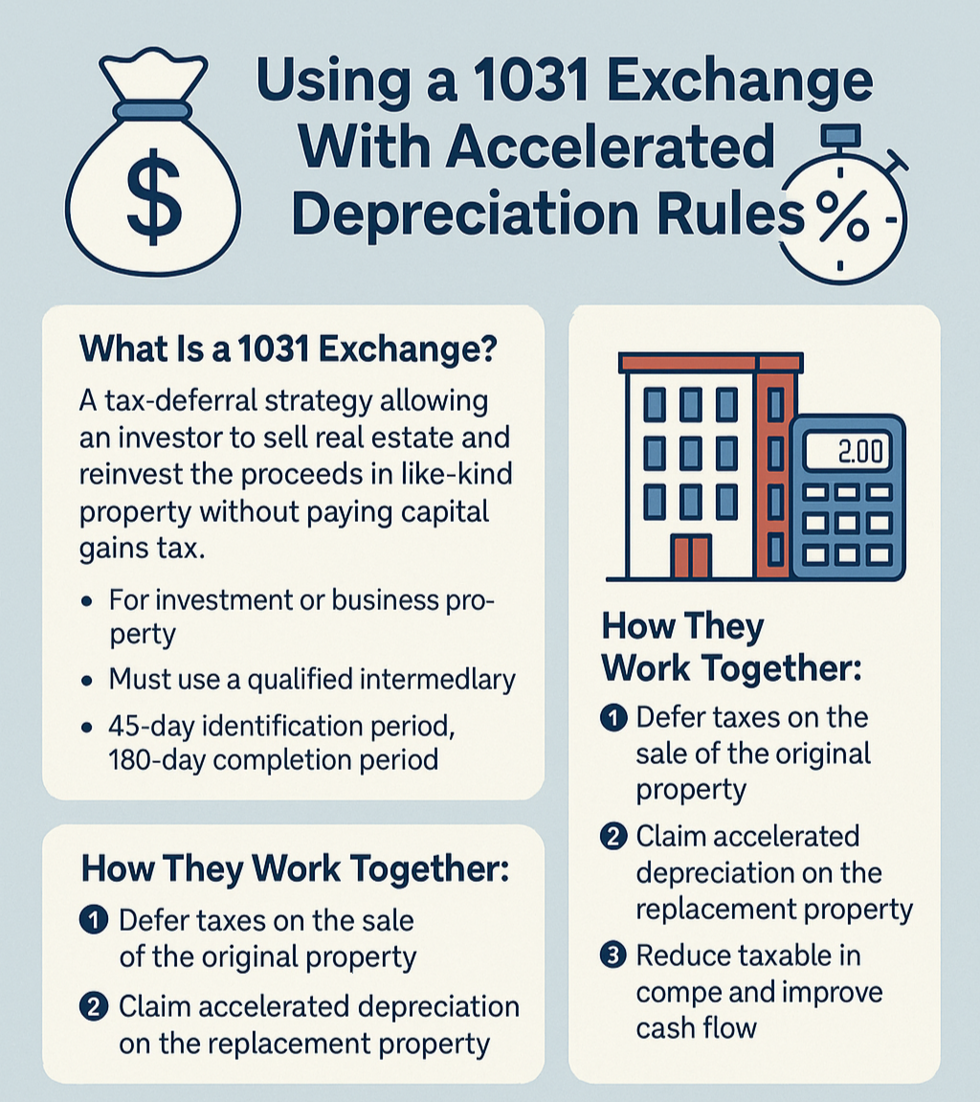
A 1031 exchange allows a taxpayer to sell investment or business real estate and roll the proceeds into a “like-kind” replacement property—deferring capital gains tax, depreciation recapture, and the net investment income tax (NIIT).
To qualify:
-
The relinquished and replacement properties must be held for investment or business use.
-
Strict timing rules apply:
-
45 days to identify replacement property.
-
180 days to close on it.
-
-
Proceeds must be held by a qualified intermediary (QI).
A compliant exchange means taxes that would normally come due at sale are deferred, freeing up more capital to reinvest.
What Are the New Accelerated Depreciation Rules?
Changes in recent federal tax legislation have created stronger opportunities for accelerated deductions in the early years of ownership. These rules make it possible to deduct more of a property's value faster, improving immediate cash flow.
Key Components:
1. Bonus Depreciation
Bonus depreciation allows taxpayers to immediately expense a percentage of the cost of certain “short-lived” assets—typically identified through a cost segregation study.
-
Even as bonus depreciation phases down from 100%, significant first-year deductions remain available.
-
Qualifying components often include HVAC systems, electrical components, flooring, parking lots, landscaping, and interior improvements.
2. Cost Segregation
A cost segregation study reclassifies components of a building into shorter depreciation lives (e.g., 5-, 7-, or 15-year property).
-
This accelerates deductions.
-
When paired with bonus depreciation, it creates a powerful front-loaded deduction strategy.
3. Expanded Eligibility Under Recent Guidance
Certain improvements and certain categories of property now benefit from faster write-offs, especially for commercial real estate.
How a 1031 Exchange and Accelerated Depreciation Work Together
A common misconception is that depreciation isn't available on a property acquired through a 1031 exchange. In reality, accelerated depreciation is fully available on the new, replacement property—regardless of whether the acquisition occurred through a tax-deferred exchange.
Here's how they reinforce each other:
1. Defer the Gain, Then Create New Losses
-
The investor sells the old property.
-
Taxes are deferred through the 1031 exchange.
-
On the replacement property, the investor can claim bonus depreciation and other accelerated deductions immediately.
This allows investors to wipe out income from the replacement property and potentially offset other passive income.
2. Increased Deductions, Not Reduced Basis
The replacement property's basis is adjusted under §1031 rules, but accelerated depreciation may still apply to the portion of the building allocated to new personal-property components (identified via cost segregation).
3. Powerful Cash-Flow Boost
Front-loaded deductions reduce taxable income in the early years, freeing up more cash to:
-
Reinvest in operations,
-
Pay down debt,
-
Improve liquidity.
4. Ideal for Portfolio Restructuring
Investors upgrading from older properties (with little remaining depreciation life) into newer ones can “refresh” their ability to take depreciation—something otherwise unavailable without exchanging.
Example Scenario
A client sells a fully depreciated rental property with a $700,000 gain. Using a 1031 exchange, they defer the entire tax bill and acquire a $1.5 million replacement property.
A cost segregation study identifies:
-
$350,000 of 5- and 15-year assets eligible for accelerated depreciation.
If bonus depreciation applies to these components, the investor may deduct most or all of this $350,000 in the first year—despite having deferred all capital gains via the 1031.
The result:
✔ Liquidity preserved through tax deferral
✔ Cash flow enhanced through immediate deductions
✔ Stronger return on investment in the first years of ownership
When This Strategy Works Best
This combined approach is especially powerful for:
-
Investors selling fully or nearly depreciated property
-
Owners upgrading into more valuable or newer assets
-
Clients seeking to shelter passive rental income
-
Long-term investors building multi-property portfolios
-
Owners planning to hold the replacement property at least 5–7 years
We often recommend pairing the 1031 exchange with:
-
A pre-exchange tax projection,
-
Financing structures that maximize depreciable basis,
-
A cost segregation study immediately following acquisition.
Key Risks & Considerations
Before pursuing this strategy, BLG helps clients analyze:
1. Basis Allocation Rules
How replacement property basis is divided between carried-over basis and new money affects depreciation calculations.
2. Passive Activity Rules
Accelerated depreciation may generate losses, but the ability to use them depends on the investor's passive/active status and other holdings.
3. State-Level Rules
Not all states conform to federal bonus depreciation or 1031 provisions.
4. The “Depreciation Recapture” Issue
These deductions produce excellent cash flow but may trigger recapture if the property is sold without another 1031 exchange.
5. Timing
Executing a 1031 exchange while coordinating financing, due diligence, and a cost segregation study requires planning.
BLG's team guides clients across these issues to ensure compliance and optimize tax outcomes.
Conclusion
Used correctly, combining a 1031 exchange with new accelerated depreciation strategies can be one of the most effective tax-planning tools available to real estate investors. This approach lets you defer taxes from the sale of your old property and immediately front-load deductions on your replacement property, producing a powerful one-two punch of tax efficiency and cash-flow enhancement.
Business Law Group regularly advises clients on structuring exchanges, coordinating cost-segregation studies, and maximizing tax benefits. If you're considering a property sale or acquisition, our team can help you model the numbers and determine whether this strategy is right for your investment goals.

Comments
There are no comments for this post. Be the first and Add your Comment below.
Leave a Comment