
When businesses and lenders enter into financing arrangements involving movable property—such as equipment, inventory, or accounts receivable—it's crucial to understand the role of the Uniform Commercial Code (UCC) in protecting those interests. Many clients are surprised to learn that filing a UCC-1 financing statement is not the first step in securing collateral. Instead, the process begins with a security agreement. Additionally, some liens arise not from contracts but automatically under the law, such as a landlord's lien.
What Is a UCC?
The Uniform Commercial Code (UCC) is a set of standardized laws governing commercial transactions across the United States. It creates a uniform legal framework for things like sales of goods, negotiable instruments, and secured transactions.
For lenders and creditors, the most relevant part is Article 9 of the UCC, which governs security interests in personal (movable) property. A properly filed UCC-1 financing statement notifies the world that a lender (or secured party) has a legal interest in certain assets of the debtor. This public filing is essential for establishing priority over other creditors. It is easiest to think about a UCC-1 financing statement as similar to a mortgage on real property, the difference is that the UCC-1 relates to "movable" or "personal" property instead of immovable or real property. So if you get a loan or other financing secured by personal property, the Lender will often take a security interest in the assets of your business or of the particular piece of equipment you are financing.
Why a Security Agreement Comes First
Before a UCC-1 can be filed, the lender must have a valid security agreement with the borrower (debtor). This agreement is the foundation of the secured transaction and must:
-
Identify the debtor and secured party
-
Describe the collateral with enough specificity to make it clear what property is covered
-
Be authenticated (signed) by the debtor
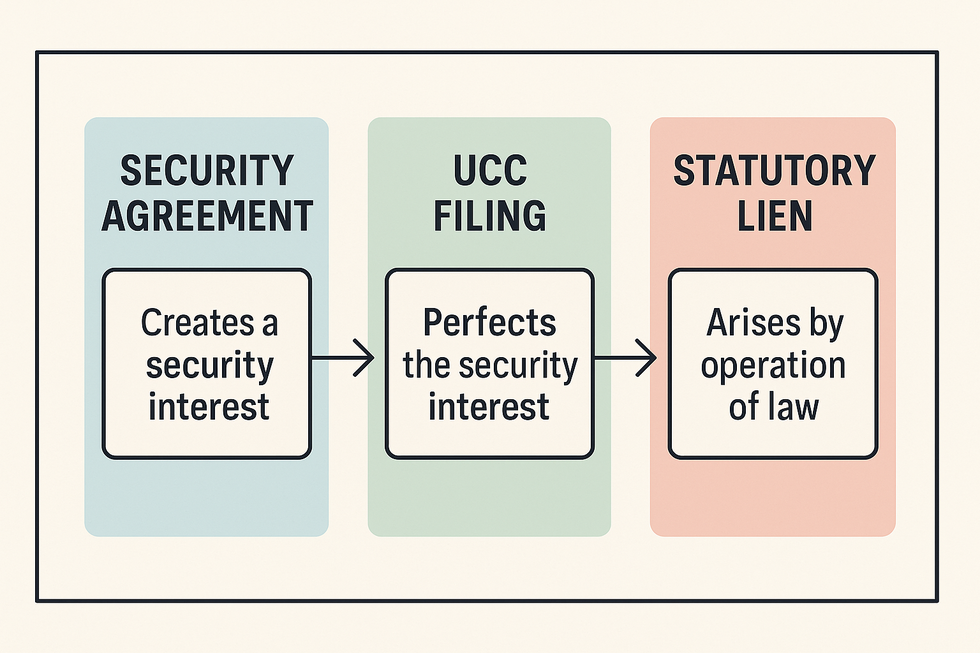
Without a security agreement, the lender has no enforceable rights in the property—even if a UCC-1 is filed. The filing alone does not create the security interest; it only perfects an interest that already exists under the agreement.
In short:
-
Security agreement = creates the lien (attachment).
-
UCC filing = makes the lien enforceable against third parties (perfection).
Liens That Arise by Operation of Law
Not all liens depend on a security agreement or UCC filing. Some are created automatically by statute or common law. A common example is a landlord's lien.
In many states, landlords have a statutory right to a lien on certain tenant property located on leased premises for unpaid rent. This lien exists by operation of law—meaning it arises automatically when the conditions are met, without a written agreement or UCC filing.
Other examples of statutory or common law liens include:
-
Mechanics' liens (for unpaid work on real property)
-
Tax liens (for unpaid federal, state, or local taxes)
-
Warehouseman's liens (for unpaid storage fees)
These liens often take priority over consensual liens created under security agreements, making it critical for both lenders and borrowers to be aware of them.
Takeaway for Business Owners and Lenders
-
A security agreement is the essential first step in creating a security interest.
-
Filing a UCC-1 financing statement perfects that interest, protecting the lender against other creditors.
-
Certain liens, like a landlord's lien, can attach to property automatically without a filing.
Understanding the distinction between contractual security interests and statutory liens is vital for protecting property rights and avoiding unpleasant surprises in the event of default.

Comments
There are no comments for this post. Be the first and Add your Comment below.
Leave a Comment